What is Superficial Organ Ultrasonography?
Superficial organ ultrasonography is an imaging method that allows examination of structures close to the skin surface using sound waves. Muscles, thyroid gland, lymph nodes, breast tissue, soft tissue structures, and tumors near the surface can be evaluated with this method. Because it does not involve radiation, it can be safely applied to all age groups. Additionally, it is a painless, fast, and practical examination, making it frequently preferred in both children and adults. Superficial organ ultrasound plays an important role in early diagnosis and guides further investigation of suspicious findings.
How is Superficial Organ Ultrasonography Performed?
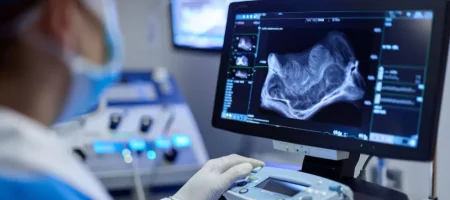
The superficial organ ultrasonography procedure is quite simple and comfortable. The patient is usually seated or lying down. A special ultrasound gel is applied to the area to be examined. This gel ensures better transmission of sound waves. Then, the device called a probe is placed on the skin, and the organs are imaged. No pain or discomfort is felt during the procedure. The examination typically lasts 10-20 minutes, and the images obtained are evaluated and reported by a radiology specialist.
Who is Superficial Organ Ultrasonography Applied To?
Superficial organ ultrasound is applied to patients who feel swelling in the neck, suspect a thyroid nodule, notice a lump in the breast, or experience pain in muscles or soft tissues. It can also be used in children for congenital masses, lymph node enlargements, or soft tissue infections. It evaluates the condition of muscles and tendons in sports injuries and is applied to patients suspected of having tumors near the skin surface. In short, superficial organ ultrasonography can be safely used in any patient with suspicious complaints.
Why is Superficial Organ Ultrasonography Requested?
This test is requested to understand the cause of masses, swelling, pain, or structural abnormalities in superficial organs. It is used to assess the structure of thyroid nodules, determine whether breast lumps are benign or malignant, and investigate infections or tumor suspicion in lymph nodes. It is also effective in diagnosing muscle and tendon injuries and detecting edema or inflammation in soft tissues. By providing early diagnosis, it helps prevent potential serious diseases.
Precautions Before Superficial Organ Ultrasonography
No special preparation is required before superficial organ ultrasonography because the organs to be examined are close to the skin, so fasting or water intake is not necessary. However, it is recommended that the area to be examined be clean and the patient wear comfortable clothing. For neck examinations, jewelry should be removed, and for breast ultrasound, comfortable clothing is preferable. In pediatric examinations, informing the child beforehand helps reduce fear and anxiety, making the process easier for both the patient and the specialist.
What Diseases Can Be Detected With Superficial Organ Ultrasonography?
This test can detect many diseases at an early stage. Conditions such as thyroid nodules, goiter, cysts, or tumors can be observed. Enlarged lymph nodes, infections, or suspected metastasis can be detected. Benign fibroadenomas or malignant tumors in breast tissue can be evaluated. Muscle and tendon tears, edema, or inflammation can also be identified with ultrasound. Soft tissue formations such as lipomas, hematomas, or abscesses are also visualized. Early results facilitate treatment before the disease progresses.
When Should Superficial Organ Ultrasonography Be Performed?
Superficial organ ultrasonography should be performed if there is a noticeable swelling in the neck, a lump in the breast, unexplained pain or swelling in muscles and soft tissues. It is also recommended for patients who require thyroid nodule follow-up, lymph node enlargement, or are at risk of breast cancer. In sports injuries, it provides rapid information about the condition of muscles and tendons. Doctors direct the examination based on suspicious clinical findings and, if necessary, proceed to further investigations.
How Long Does Superficial Organ Ultrasonography Take?
Superficial organ ultrasonography is a short and practical examination. It usually takes between 10 and 20 minutes. However, if multiple areas need evaluation, the duration may be slightly longer. During the procedure, the patient sits or lies down, gel is applied to the relevant area, and images are taken with the probe. No pain is felt; the gel on the skin may feel slightly cool. Quick results are a major reason why patients prefer this method.
Superficial Organ Ultrasonography Prices 2026
In 2026, superficial organ ultrasonography prices may vary depending on the center, the quality of the device, and the doctor’s experience. In public hospitals, the procedure is usually free under the Social Security Institution (SGK), while private hospitals or imaging centers may charge a fee. In private centers, prices typically range between 3,000 TL and 7,500 TL. Additional examinations may increase the cost. Patients are advised to obtain the most accurate price information from the relevant institution before the procedure.
How is Superficial Ultrasound Performed?
Superficial ultrasound is a method that allows imaging of organs and tissues close to the skin surface. During the procedure, the patient is usually seated or lying down. A transparent and lubricating gel is applied to the area to be examined. This gel improves transmission of sound waves and ensures clearer images. Then, the device called a probe is placed on the skin, transmitting sound waves and capturing reflected images on the device screen. The patient does not feel any pain. The examination, lasting approximately 10-20 minutes, allows detailed assessment of the thyroid gland, breast tissue, lymph nodes, muscles, and superficial tumors.
Why is Soft Tissue Ultrasound Performed?
Soft tissue ultrasound is performed to evaluate muscles, tendons, ligaments, subcutaneous tissues, and superficial tumors. Muscle tears, ligament injuries, or tendon inflammations due to sports injuries can be imaged. It is also preferred to understand the cause of swelling, masses, lipomas, abscesses, or hematomas under the skin. Congenital swellings in children and soft tissue injuries due to trauma in adults can be easily detected. Since it does not contain radiation, it is a safe and repeatable method.
How is Ultrasonographic Examination Performed?
Ultrasonographic examination is performed by a radiology specialist using special devices. The patient is positioned according to the area to be examined. Gel is applied to the skin, and images of organs or tissues are captured using a probe. Sound waves are transmitted into the body, and reflected waves are displayed on the device screen. This allows assessment of organ size, structure, and potential disease signs. The patient may be asked to move, breathe, or allow images from different angles. The method is completely painless and quick, and the obtained images are reported by a specialist.
What is Ultrasonography Used For?
Ultrasonography is one of the safest imaging methods used for both diagnosis and follow-up. It is used to examine internal organs such as the liver, kidneys, gallbladder, and pancreas, assess masses in the thyroid and breast tissue, monitor fetal development during pregnancy, and visualize blood vessels. It is also preferred for muscle, tendon, and soft tissue injuries. Its main advantages are early diagnosis, absence of radiation, and fast application. It can be safely used in both children and adults and guides further advanced investigations when necessary.
Which Organs are Examined in Full Abdominal Ultrasound?
Full abdominal ultrasound allows simultaneous examination of multiple organs in the abdominal cavity. This includes the liver, gallbladder, bile ducts, spleen, pancreas, kidneys, stomach, and parts of the intestines. Additionally, adrenal glands, major blood vessels, and the urinary bladder can be assessed. This provides evaluation of both upper and lower abdominal organs in a single examination. Enlargement, cysts, stones, tumors, inflammation, or fluid accumulation can be detected via ultrasound. It is commonly preferred for patients with abdominal pain, bloating, urinary problems, or digestive issues.
Where is Ultrasound Performed?
Ultrasound can be performed in public hospitals, university hospitals, and private imaging centers. Many private clinics also provide ultrasound services. The examination is conducted by specialists in radiology departments. Pregnancy ultrasounds are done in obstetrics clinics, while kidney and bladder ultrasounds are performed in urology departments. In short, ultrasound is a widely used method available in many healthcare facilities. Usually, an appointment is required, but in emergencies, it can be performed quickly.
What is Evaluated During Ultrasound Examination?
During ultrasound examination, different structures are evaluated depending on the area. Abdominal ultrasound examines the liver, kidneys, spleen, and pancreas; thyroid ultrasound examines the neck region; breast ultrasound evaluates breast tissue. In women, gynecological ultrasound visualizes the uterus and ovaries; in men, scrotal ultrasound examines the testes. Doppler ultrasound evaluates blood flow and vascular obstructions or clots. Pregnancy ultrasounds monitor fetal growth, heart rate, and organ development. Ultrasound helps determine the cause of current complaints and enables early detection of many diseases.
Why is Water Drunk Before Ultrasound?
For certain ultrasound examinations, especially of the lower abdomen and urinary system, patients are asked to have a full bladder. A full bladder provides clearer images of its structure and surrounding organs. It also reduces interference from intestinal gas. Therefore, patients are instructed to drink a certain amount of water before the procedure. For upper abdominal ultrasound, fasting is usually required and water is not recommended. Preparation should always follow the doctor’s instructions.
What are the Ultrasound Tests?
Ultrasonography is a versatile method used to examine organs and tissues in different regions. Full abdominal ultrasound is preferred for general evaluation of abdominal organs; upper abdominal ultrasound focuses on the liver, gallbladder, pancreas, and spleen. Lower abdominal ultrasound evaluates the urinary bladder, bladder, and reproductive organs. Gynecological ultrasound is applied in women, scrotal ultrasound in men. Thyroid ultrasound examines the thyroid gland and nodules. Doppler ultrasonography evaluates blood flow in vessels. Superficial organ ultrasound is used for muscles and tendons in sports injuries, and detailed ultrasound evaluates fetal development during pregnancy.
Is Detailed Ultrasound Available in Public Hospitals?
Detailed ultrasound is available in public hospitals. Detailed fetal development screening during pregnancy is usually performed by obstetrics specialists and radiology departments. Ultrasound is also used in public hospitals for detailed examination of the liver, kidneys, pancreas, and other internal organs. However, due to high demand, appointment times may be longer than in private centers. Covered by SGK, these services do not create extra costs for patients. Therefore, patients can safely apply to public hospitals for detailed ultrasound.
Ultrasound or Ultrasonography?
The correct medical term is ultrasonography. Ultrasound is the common short term used by the public. Ultrasonography refers to obtaining images by reflecting high-frequency sound waves off tissues and organs. While ultrasound can refer to the device, ultrasonography is the scientific name of the examination method. Both words are used interchangeably in daily life, but medical reports use “ultrasonography.”
Why is a Full Bladder Ultrasound Performed?
A full bladder ultrasound is requested mainly for lower abdominal and urinary system examinations. A full bladder allows clearer imaging of its structure and surrounding organs. When empty, the bladder wall appears collapsed, obscuring details. A full bladder helps show the flow of urine from the kidneys and the bladder’s emptying capacity more accurately. This method also provides more accurate results in cases of urinary incontinence, bladder reflux, or kidney disease suspicion.
What is Detailed Ultrasound Screening?
Detailed ultrasound screening is a special examination, particularly during pregnancy, to evaluate fetal organ development. Conducted between the 18th and 23rd weeks, it assesses the brain, heart, kidneys, spine, stomach, intestines, and extremities. Potential congenital anomalies can be detected early. Detailed ultrasound is also used to detect masses, tumors, or structural abnormalities in abdominal organs. It is more comprehensive than a standard ultrasound and is usually performed by experienced specialists.
Why is Groin Ultrasound Performed?
Groin ultrasound is performed in patients with pain, swelling, or a palpable mass in the groin region. It evaluates the condition of the testes in men and ovaries and uterus in women. It is also preferred in cases of suspected hernia, lymph node enlargement in the groin, or vascular diseases. Sports injuries affecting muscles and tendons can also be assessed with this method. The procedure is painless, radiation-free, and provides rapid results.