What is MR Tensor and Tractography?
Magnetic Resonance Tensor Imaging and Tractography is an advanced imaging method used to examine the brain’s white matter pathways. The nerve fibers inside the brain form a very complex network. These connections play a fundamental role in brain function. The tensor method measures how water molecules move along nerve fibers, making it possible to map white matter pathways. Tractography then transforms these measurements into three-dimensional visuals, revealing communication pathways in the brain in detail. It is especially important in evaluating neurological diseases, planning brain surgery, and determining the effect of tumors on surrounding tissues.
How is MR Tensor and Tractography Performed?
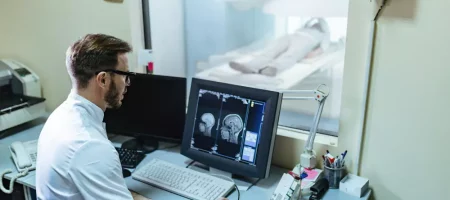
This imaging method is performed using standard MRI machines with special software and scanning protocols. The patient lies on their back in the MRI scanner and is asked to remain still. During the procedure, sequences specially designed for the brain are used to record the movement directions of water molecules. These data are then analyzed with computer programs to create three-dimensional images of white matter pathways. The procedure is painless and does not involve radiation. The duration varies depending on the technical specifications of the device and the protocol used, but it usually takes between 30 and 60 minutes. The resulting images are interpreted by radiologists and turned into a report.
What Does MR Tensor and Tractography Mean?
In medical literature, a tensor is a mathematical model that measures the directional movement of water. Tractography is defined as the visualized form of this mathematical data. In short, MR tensor and tractography make invisible nerve pathways inside the brain visible. This method allows for detailed understanding of which pathways are intact, which are damaged, or which are affected by a lesion such as a tumor. Thus, both disease diagnosis becomes easier and surgical interventions can be conducted more safely.
Why is MR Tensor and Tractography Requested?
This test is especially preferred in brain surgery, neurology, and oncology. When planning surgery for brain tumors, the proximity of the tumor to nerve pathways is critical. Tractography helps protect vital nerve pathways during surgery. In stroke, multiple sclerosis, and traumatic brain injuries, it reveals which pathways are affected. Additionally, mapping white matter pathways is important before epilepsy surgery. This method, which assesses the structural integrity of nerve fibers, guides doctors not only in diagnosing diseases but also in preparing treatment plans.
Diseases Detected by MR Tensor and Tractography
This method, which examines the brain’s white matter, plays an important role in detecting diseases affecting nerve pathways. In stroke patients, it helps determine which pathways are damaged, guiding rehabilitation. In demyelinating diseases such as multiple sclerosis, nerve fiber damage can be visualized in detail. The effect of brain tumors on surrounding tissues and nerve pathways is clearly revealed, aiding surgical planning. Traumatic brain injuries also benefit from assessment of nerve pathway integrity. Neurological diseases like epilepsy and Alzheimer’s can be evaluated for white matter connectivity, contributing to diagnosis. Therefore, tensor and tractography are not just imaging tools but also valuable for monitoring disease progression and guiding treatment.
When Are MR Tensor and Tractography Results Available?
After the scan, the collected data are processed on a computer to create three-dimensional images of white matter pathways. Preparing these data and converting them into a detailed report depends on the technical capacity of the device and the patient’s clinical condition. Results are generally ready within a few days after the scan. In some cases, especially in emergencies, radiologists may provide a preliminary evaluation sooner. However, when detailed analysis is required, preparing the report may take a few days. Results are usually interpreted by a neurosurgeon or neurologist, considering the patient’s overall condition.
Precautions Before MR Tensor and Tractography
Before the scan, there are some important points the patient should consider. Patients with metal prostheses, pacemakers, brain clips, or any metal implants must inform their doctor. The MRI device has a strong magnetic field, so all metal objects must be removed. Jewelry, watches, credit cards, or any magnetically sensitive items should not enter the scanner. Remaining still during the procedure is crucial for image clarity. Mild sedation may be used for children or patients who have difficulty staying still. Additionally, special preparation may be required according to the doctor’s instructions.
Which Department Handles MR Tensor and Tractography?
This test is performed in the radiology department, and the images are evaluated by radiologists. However, for the results to gain clinical significance and guide treatment, they are also reviewed by a neurologist or neurosurgeon. Brain tumors, epilepsy surgery, multiple sclerosis, or traumatic brain injuries are most commonly assessed by neurology and neurosurgery. Therefore, the procedure requires a multidisciplinary approach. Radiologists interpret the images, neurologists assess them alongside clinical findings, and neurosurgeons use the data for surgical planning if needed.
How Long Does MR Tensor and Tractography Take?
The duration depends on the technical specifications of the device, applied protocols, and patient condition. While a standard MRI typically takes 20-30 minutes, tensor and tractography scans take longer due to more detailed data collection, usually 45 minutes to 1 hour. In some cases, especially when high-resolution 3D images are required, the time may increase further. Remaining completely still during the scan is essential, as even small movements can blur images. This is particularly relevant for children or patients who cannot stay still for long periods. Another factor is the processing of the data and conversion into 3D tractography images, which affects the time for the results to reach the patient.
MR Tensor and Tractography Prices 2026
Fees vary depending on the complexity of the procedure, the equipment of the facility, and the city. As an advanced imaging technique, it is generally more expensive than standard MRI scans. As of 2026, prices in private health centers range from approximately 3,000 TL to 10,000 TL. In public hospitals, costs may be lower, and in certain indications, the Social Security Institution may cover expenses. Device quality, advanced software, and expert interpretations directly affect pricing in private centers. Therefore, getting updated information from the center where the procedure will be performed is the most accurate approach.
What is DTI Brain and Tractography?
This method examines the brain’s white matter pathways, visualizing communication networks by analyzing how water molecules move along nerve fibers. Diffusion tensor imaging (DTI) is an MRI technique that evaluates microscopic structures in the brain. Tractography converts these data into three-dimensional images, producing a detailed map of white matter pathways. It is particularly important in brain tumors, traumatic brain injury, stroke, and dementia, as it shows the extent to which white matter pathways are affected. This method is critical not only for diagnosis but also for surgical planning.
What is Diffusion Tensor Imaging?
Diffusion tensor imaging is an advanced MRI technique that measures the direction and speed of water molecules in the brain. Unlike standard MRI, it provides cellular-level information, not just anatomical structure. Water molecules move along white matter fibers in a specific direction. Measuring this movement provides important information about the integrity of white matter pathways. DTI helps determine whether nerve fibers are damaged or intact. Therefore, it is widely used in stroke, multiple sclerosis, traumatic brain injury, and brain tumors.
What is a Diffusion Tensor?
A diffusion tensor is a measurement that mathematically defines how water moves along white matter fibers. Each tensor describes water movement in three-dimensional space. Since white matter pathways are linear, water molecules move faster along them. Tensor measurements convert these movements into mathematical data, mapping white matter connectivity. This information helps understand functional connections in the brain and shows which pathways are affected by disease. Thus, the concept of diffusion tensor forms the basis of tractography and DTI.
Can Brain Damage Be Seen on MRI?
Magnetic resonance imaging provides high-resolution views of brain tissue. In suspected brain injury, it clearly shows tissue structure and potential damage areas. Post-trauma swelling, bleeding, or tissue loss can be easily detected on MRI. Structural changes over time, disruptions in white matter pathways, or nerve cell damage can also be evaluated. Special sequences like diffusion MRI measure water movement, revealing areas where cells have lost function. Therefore, brain injuries can be detected in both early and chronic phases, providing critical information for treatment planning.
Why is Perfusion MRI Requested?
Perfusion MRI measures blood flow in brain tissue, especially in cases of vessel blockage, stroke, or suspected tumor. It shows how much blood reaches tissues, how oxygenation occurs, and whether cells remain viable. In stroke patients, perfusion MRI identifies at-risk areas and guides treatment. In brain tumors, it evaluates tumor vascularization, aiding diagnosis and treatment planning. Perfusion MRI is also used to monitor treatment response. In short, it directly measures brain tissue health and viability, making it critical in many neurological diseases.
How Long Does Non-Contrast Brain MRI Take?
Non-contrast brain MRI typically takes 15 to 25 minutes using standard protocols. Duration varies depending on device strength, number of sequences, and patient’s ability to remain still. Patients must remain stationary, as movement degrades image quality. Some centers use rapid scanning protocols, which may shorten the time. For detailed examinations, duration may increase. Non-contrast MRI is performed without contrast agents, is faster, and is usually the first choice.
Is Diffusion MRI Contrast-Enhanced?
Diffusion MRI is a non-contrast imaging method. No contrast agent is used. It measures water movement within cells to evaluate cellular viability. This is especially critical in stroke diagnosis, as water movement changes in cells deprived of oxygen and nutrients, detectable early by diffusion MRI. Patients are only asked to remain still, and no drug preparation is needed. Thus, it is a safe, quick, and non-invasive method.
When is Diffusion MRI Performed?
Diffusion MRI is preferred in many diseases because it shows cellular-level changes in the nervous system. It is the first choice in suspected brain vessel blockage or stroke, as it can detect damage early and guide timely treatment. It also provides valuable information in brain tumors, white matter disorders, and infections. Traumatic brain injury can be assessed for tissue integrity. It is sometimes used to localize epilepsy foci or study conditions like dementia.
What is a Brain Diffusion Report?
A brain diffusion report is a medical document prepared by an expert radiologist after performing diffusion MRI. It examines water molecule movement in different brain regions and evaluates cell health. This is critical in stroke diagnosis, as oxygen-deprived cells restrict water movement, highlighted in the report. Tumors, traumatic injuries, infections, and demyelinating diseases are also detailed. The report usually includes MRI-derived measurement values, location and size of abnormalities, and clinical significance. The conclusion may suggest a possible diagnosis or recommend further tests.
How Does MRI Work?
Magnetic resonance imaging visualizes tissues using strong magnetic fields and radio waves. Hydrogen atoms in water molecules, which make up most of the body, are aligned in the magnetic field. Radiofrequency waves excite these atoms, which emit signals as they return to their original state. These signals are captured and converted into images by a computer. MRI does not use radiation like X-rays or CT, making it a safe technique. Various sequences can visualize not only anatomy but also biochemical changes within tissues.
Why is Contrast Brain MRI Requested?
Contrast brain MRI is preferred to better visualize blood vessels, tumors, and inflammatory processes. The contrast agent, usually containing gadolinium, is administered intravenously. It accumulates in highly vascularized areas, enhancing image clarity. In brain tumors, it shows lesion boundaries and relationships with vascular structures. In infections and inflammatory processes, it provides valuable information. In multiple sclerosis, it identifies new and active lesions. Thus, contrast MRI plays a critical role in diagnosis and treatment planning.
How is Brain MR Venography Performed?
Brain MR venography is a specialized MRI technique to visualize the brain’s venous structures. A standard MRI machine is used with sequences that highlight veins. In most cases, non-contrast imaging is sufficient, but for detailed assessment, intravenous contrast may be administered. The patient lies on their back in the scanner and remains still for several minutes. The resulting images provide a 3D view of the brain’s venous circulation. Vessel blockages, clots, or structural anomalies can be clearly seen.
Precautions During Brain MRI
Safety and image quality require attention to certain points. Patients with metal implants, pacemakers, brain clips, or prostheses must inform staff, as the MRI’s strong magnetic field can affect these devices. All jewelry and magnetically sensitive objects must be removed. Patients should remain still, as movement reduces image quality. For those with claustrophobia, sedatives or open MRI may be considered. Children or patients unable to stay still may receive mild sedation. If contrast is used, kidney function must be evaluated beforehand.
How Long Does Contrast Brain MRI Take?
Contrast-enhanced brain MRI generally takes longer than standard scans. Non-contrast MRI usually takes 15-25 minutes, while contrast scans take about 30-45 minutes. The longer duration is due to administering the contrast agent and repeating images. Initially, non-contrast images are acquired, then contrast is injected and scanning is repeated. This improves visualization of tumors, vascular structures, and inflammatory areas. Remaining still is critical for image quality. A brief post-procedure observation may be conducted to monitor for allergic reactions.
What Does Diffusion Restriction Mean in MRI?
Diffusion MRI measures water movement inside cells. Under normal conditions, water moves freely. Diffusion restriction indicates impaired cellular function and restricted water movement. This is especially important in stroke cases, where oxygen-deprived cells swell and restrict diffusion, appearing as bright areas on MRI. Tumors, abscesses, infections, or metabolic disorders can also cause diffusion restriction. The report highlights cellular-level problems, indicating the need for detailed evaluation.
What is Diffusion?
Diffusion is the free movement of water molecules or other particles from high to low concentration areas. In the intercellular fluid, molecules move naturally from dense to less dense regions. This process is crucial for biological function. Measuring diffusion in MRI provides information about tissue health. In healthy tissues, water moves in an organized way, while in damaged or dead cells, movement is disrupted. Diffusion measurement reveals cellular-level changes, aiding early disease detection and treatment planning.
Can Tumors Be Seen on Non-Contrast MRI?
MRI without contrast provides high-resolution images and can detect many tumors. Large tumors, brain displacement, and pressure effects on surrounding tissues can be seen. However, small tumors, unclear lesions, or those related to vessels may not be visible on non-contrast images. Therefore, contrast-enhanced MRI may be requested to fully assess the tumor’s size, type, and spread. Non-contrast MRI provides general information but may be limited for detailed diagnosis.
Why is Contrast-Enhanced MRI Performed?
Contrast MRI evaluates blood vessels, tumors, and inflammatory foci in more detail. The intravenously administered contrast accumulates in highly vascularized areas, clearly highlighting abnormalities. It helps identify tumor boundaries, effects on surrounding tissues, and vascular relationships. It also detects new and active lesions in multiple sclerosis. In brain abscesses, vascular malformations, and inflammation, contrast MRI provides detailed insights. Therefore, it is critical for diagnosis and treatment planning.
What to Do After Contrast MRI?
Patients usually do not need special precautions after contrast MRI. The contrast agent is excreted through the kidneys. Drinking plenty of water can speed up this process. Daily activities can be resumed immediately. Rarely, allergic reactions may occur, including itching, rash, or shortness of breath, in which case medical attention is required. Patients with kidney disease must be evaluated by a doctor before contrast administration. Generally, no restrictions apply, and patients can eat, walk, and continue routine activities after the procedure.