What is CT Angiography?
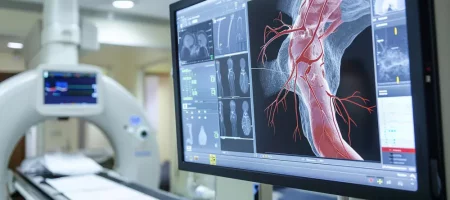
CT angiography is an advanced imaging method used to examine the structure and function of blood vessels in detail. Performed with a computed tomography device, this procedure uses a contrast agent to visualize the interior of blood vessels more clearly. It is especially useful for detecting vessel narrowing, blockages, aneurysms, and blood clots. We use the most advanced devices for CT angiography, providing our patients with reliable and detailed results.
How is CT Angiography Performed?
Before the procedure, an intravenous line is established, and the contrast agent is administered to obtain clearer images. The patient lies in the computed tomography device and is asked to remain still during the procedure. The device captures images of the vessels from different angles, allowing a detailed examination. The scan usually takes 10-20 minutes. We perform CT angiography comfortably and safely for our patients, enabling them to return to daily life shortly after the procedure.
Why is CT Angiography Requested?
Doctors may request CT angiography when vascular diseases are suspected, or when symptoms such as chest pain, shortness of breath, dizziness, stroke risk, or severe leg pain occur. This method is commonly used to examine heart and brain vessels. It is also preferred for pre-treatment planning and prior to surgical interventions. We carefully perform CT angiography to ensure our patients reach an accurate diagnosis as quickly as possible.
What are the Application Areas of Cardiac CT/Coronary CT Angiography?
Coronary CT angiography is one of the most important methods for evaluating heart vessels. It is used to determine narrowing or blockages in heart vessels, assess the risk of heart attack, and for follow-up after stent placement or bypass surgery. Additionally, it can be applied to lung and brain vessels. We perform coronary CT angiography meticulously, providing our patients with early and accurate information about their heart health.
In Which Conditions is Cardiac CT/Coronary CT Angiography Used?
Coronary CT angiography plays a crucial role in diagnosing heart vessel diseases. It can detect coronary artery disease, vessel narrowing, hardening, clot formation, and aneurysms. It is also used to evaluate patients at risk of heart attack, investigate the cause of chest pain, and examine heart valve diseases. We aim to improve our patients’ quality of life with cardiac CT and contribute to making the most accurate diagnosis.
What Are the Distinguishing Features of Cardiac CT/Coronary CT Angiography?
Coronary CT angiography is an advanced method that shows the structure and blood flow of heart vessels in detail. Its main advantages are faster results, less invasiveness, and lower risk compared to traditional methods. Narrowing, blockages, or clots that may lead to a heart attack can be detected early. Moreover, 3D imaging allows a detailed evaluation of heart vessel anatomy. We perform coronary CT angiography using the most advanced devices, offering reliable and fast results.
How is the Cardiac CT/Coronary CT Angiography Process?
Before the procedure, an intravenous line is established and the contrast agent is administered. The patient lies in the computed tomography device, and the device captures images from different angles to clearly visualize specific areas of the heart. The procedure usually takes about 15-20 minutes. Remaining still during the scan is important. We ensure the process is comfortable for our patients, providing detailed pre- and post-procedure information for a safe experience.
Who is CT Angiography Applied To?
CT angiography can be applied to patients at risk for heart vessel disease, experiencing chest pain, with a family history of heart attack, or experiencing shortness of breath. It is also preferred for those suspected of aneurysms in brain vessels or blockages in leg vessels. We thoroughly evaluate our patients and safely perform CT angiography on suitable candidates.
How to Prepare for CT Angiography?
Patients may need to fast before the procedure. Kidney function tests may be requested due to the contrast agent. Avoiding caffeinated beverages and monitoring medications that regulate heart rate are also part of preparation. Jewelry, metal accessories, and belts should be removed. We provide detailed preparation instructions to ensure patients complete the process smoothly.
What is Catheter Angiography?
Catheter angiography is a traditional method in which a thin tube (catheter) is inserted into a blood vessel. During the procedure, contrast agent is directly injected into the vessel to visualize it. Catheter angiography can be used for both diagnosis and treatment, such as placing stents or removing clots. We guide patients requiring catheter angiography and ensure these procedures are safely performed when necessary.
CT Angiography Prices 2026
Prices vary depending on the center, device technology, use of contrast agent, and the area being examined. For a simpler CT angiography procedure in private hospitals, the cost can range approximately between 8,000 TL and 15,000 TL.
Contact us for pricing, as each patient’s condition and needs differ. Our goal is to provide high-quality service at affordable conditions and ensure patients reach the correct diagnosis as quickly as possible.
What Are the Disadvantages of Cardiac CT/Coronary CT Angiography?
Coronary CT angiography is very effective for examining heart vessels. However, like any medical procedure, it has some disadvantages. The contrast agent used may rarely affect kidney function or cause allergic reactions. There is also a small radiation exposure. High heart rates may reduce image clarity. We minimize these risks by providing detailed patient information before the procedure and ensuring a safe scanning process.
Who Should Not Undergo Cardiac CT/Coronary CT Angiography?
This method may not be suitable for everyone. It is not recommended for patients with kidney failure, severe contrast allergies, or uncontrolled heart rhythm disorders. It is generally avoided during pregnancy due to radiation risk. Very obese patients may also face challenges in obtaining clear images. We evaluate patients’ medical histories carefully and direct them to alternative imaging methods if necessary.
Precautions After Cardiac CT/Coronary CT Angiography
After the procedure, it is important to drink plenty of fluids to help flush the contrast agent from the body. Mild dizziness, nausea, or fatigue may occur. Patients should rest as recommended and avoid strenuous activities. Any unusual symptoms should be reported to the doctor immediately. We provide detailed post-procedure guidance to ensure patients safely return to daily life.
Can You Be Around Pregnant Women or Small Children After Cardiac CT?
Since no radiation remains in the body after CT angiography, patients can safely be around pregnant women or small children. However, if contrast agent was used, breastfeeding mothers may need to express and discard milk for a certain period. We provide all necessary guidance to eliminate potential risks.
Is There Any Pain During Cardiac CT?
CT angiography is a painless and quick procedure. Patients may feel a slight needle prick during IV line placement. The contrast agent may cause a brief sensation of warmth. No other pain is experienced. We ensure the procedure is as comfortable as possible.
Does CT Angiography Give Definitive Results?
CT angiography is highly reliable for evaluating heart vessels. It can detect narrowing, blockages, clots, or vessel hardening. However, classic catheter angiography may sometimes be required for confirmation. It remains one of the most important tools for early diagnosis. We provide reliable results and guide patients to further tests if needed.
Does CT Angiography Hurt?
CT angiography is a painless and fast imaging method. During IV line placement, only a short needle prick is felt. When the contrast agent is administered, a brief warm sensation or metallic taste may occur. No other pain is experienced. We perform the procedure comfortably to ensure patient ease.
Precautions After CT Angiography
After the procedure, drinking plenty of fluids helps eliminate the contrast agent. Mild dizziness, nausea, or fatigue may occur, so short rest is advised. Heavy exercise should be avoided, and doctor’s recommendations followed. Rare allergic reactions may occur, requiring immediate medical attention. We provide detailed guidance to ensure patients safely return to daily life.
Is Coronary CT Angiography Risky?
As a non-invasive method, it carries much lower risk than traditional angiography. However, caution is required for patients with kidney disease due to contrast agent use. Rare allergic reactions may occur. Radiation exposure is low and kept within safe limits. Generally, it does not pose serious risk for healthy individuals. We carefully evaluate patients’ medical histories and minimize potential risks.
Who Performs CT Angiography?
The procedure is performed by radiology specialists. Radiology technicians operate the device while the specialist evaluates and reports the images. Cardiologists and cardiovascular surgeons use these reports to plan diagnosis and treatment. We perform CT angiography safely with an experienced radiology team and deliver results to relevant specialists promptly.
Does Social Security Cover Coronary CT Angiography?
The Social Security Institution (SGK) may cover coronary CT angiography in certain cases, usually requiring a doctor’s referral and medical justification. In private hospitals, costs vary depending on SGK agreements. Contact us for pricing, as each patient’s situation and the facility differ, ensuring cost-effective and quality service.
Is CT Angiography Performed With Medication?
CT angiography typically uses a contrast agent administered intravenously. This agent makes the interior of vessels clearly visible, revealing blockages, narrowing, or clots. Some scans can be done without contrast, but for the clearest results, the contrast method is preferred. We safely administer contrast and thoroughly inform patients beforehand.
Can CT Detect Vessel Blockages?
Computed tomography, especially CT angiography, is highly effective for detecting vessel blockages. Plaques, narrowings, and clots in vessel walls can be clearly visualized. This allows early diagnosis for patients at risk of heart attack, stroke, or circulatory disorders. We use modern devices to provide detailed imaging and reliable reports.
Can You Drink Water Before CT Angiography?
Fasting for a few hours may be required before the procedure. Drinking water is usually allowed and can help kidney function if contrast agent is used. Following the doctor’s specific instructions is essential. We provide detailed preparation guidance for optimal results.
Who Should Undergo Coronary Angiography?
Coronary angiography is performed on patients suspected of heart vessel narrowing or blockages, experiencing chest pain or exertional shortness of breath, at high risk for heart attack, or with previous heart disease. Individuals with a family history of heart disease may also undergo early screening. We ensure accurate evaluation of heart health and safely guide patients through the treatment process.
Should Blood Thinners be Stopped Before Angiography?
Patients must inform their doctor about blood-thinning medications before the procedure. In some cases, temporary discontinuation may be necessary. Each patient’s situation differs, so doctor’s instructions must be followed. We carefully review all medications to ensure a safe procedure.
Is CT Angiography Available in Public Hospitals?
Many public hospitals in Turkey offer CT angiography, especially large research and training hospitals in major cities. Appointment times may be long due to demand. We facilitate faster and more comfortable testing. CT angiography is widely used in public hospitals for evaluating heart and vascular health. Contact us for pricing and solutions.
Can Heart Attack Occur After Angiography?
The risk of heart attack after angiography is very low but not zero. It may occur in patients with severely blocked vessels or a history of heart disease. Rare complications such as vessel damage or clot formation may occur. Modern devices and expert physicians minimize these risks. We closely monitor patients after angiography to ensure safety.
What Should the Pulse Be During CT Angiography?
For optimal imaging, heart rate should be within a specific range, generally 60-70 beats per minute. Higher heart rates may reduce image quality, and medications may be given to lower it if necessary. We check patients’ heart rates to ensure the clearest images.
Are Angiography and Stent the Same Thing?
Angiography and stent are related but not the same. Angiography is a diagnostic procedure to visualize vessels, while a stent is a small metal tube placed to open a narrowed or blocked vessel. Angiography detects the problem, and stent placement is a treatment. We guide patients through both diagnosis and treatment to safeguard heart health.
What Are the Side Effects After Angiography?
Mild side effects may occur, such as bruising, slight pain, or swelling at the catheter entry site. Contrast agent use may rarely cause allergic reactions, and temporary kidney function changes may occur in very rare cases. These side effects are usually short-lived and not serious. We closely monitor the post-angiography process to ensure patient safety.